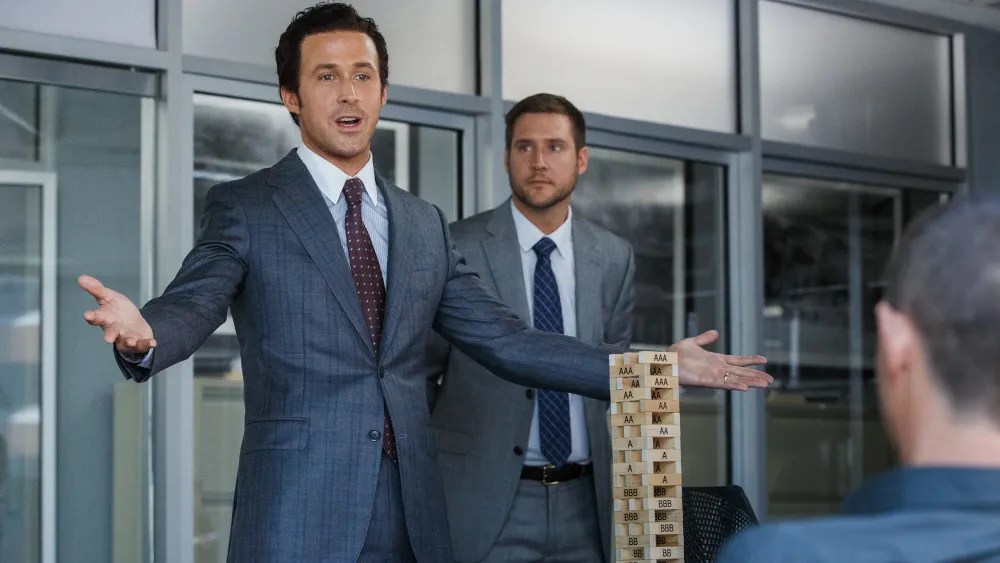
In a brilliant, and hilarious scene, in The Big Short – a movie about those outsiders who managed to predict the 2008/09 crash and short their positions (thereby making money) off of the collapse of the entire global housing market.
In this particular scene, Ryan Gosling is strying to convince Steve Carell to buy into his plan. His claim? That the tranches of ‘AAA’, ‘AA’, ‘A’ and ‘B’ had suddenly become full of rubbish debt obligations. This was partly due to the ratings agencies – if they did not give each tranche a maximum rating then banks could simply walk down to their competitiors. Also, the bankers did not care as they were earning commission for every mortage they sell.
It was corrupt from the ground up.
Again, as Gosling’s character says – “what used to be considered ‘A’s’ and ‘BBB’s as rubbish. They had:
- Rock bottom FICO scores
- No income-varification
- Adjustable rates
Rather more interesting than my re-count of a great movie is something extremely interesting which Steve Carell says at teh end of the scene. He is obviously sceptical of this – assuming that they someone else would have surely noticed this before him.
He comments, “But default rates are already up from 1% to 4% and it will continue to rise …?
Gosling replies, “Exactly – and if they rise to 8% (and they will!) the triple B’s will default too!”
“I am standing in front of a burning building, AND I AM OFFERING YOU FIRE INSURANCE ON IT!”
Guess what the default rate at the end of 2023? It was 3.45% and without being too technical that is because every country is pumping money into their own economies and this obviously cannot continue forever. This seems like a no-brainer I have been searching for angel investors, mostly amongst friends and family but if anyone wants to get into this at the ground floor hit me up
In the intricate dance of economics, there comes a time when the music stops, and the party takes an unexpected turn. For the United States, that time may be fast approaching as ominous signs suggest the country is overdue for a recession. From economic indicators to historical precedents, the writing on the wall is becoming increasingly difficult to ignore.
Let’s take a closer look at the evidence.
- Economic Indicators: The economic indicators flashing red are hard to ignore. Despite periods of growth and resilience, recent signals hint at underlying weaknesses. For instance, while the unemployment rate has declined, wage growth has been sluggish, and labor force participation remains below pre-pandemic levels. Additionally, inflationary pressures are mounting, fueled by supply chain disruptions and increased demand as the economy reopens.
- Historical Precedents: History has a way of repeating itself, and the cyclical nature of recessions is well-documented. According to economic theory, expansions are typically followed by contractions, and the U.S. economy has been in expansion mode for an unusually long time. Since the Great Recession of 2008, the country has experienced one of the longest economic expansions on record, leading many experts to speculate that a correction may be overdue.
- Global Economic Trends: The interconnected nature of the global economy means that trends abroad can have ripple effects at home. Recent developments, such as slowing growth in key international markets and escalating trade tensions, could further exacerbate economic headwinds for the United States. Moreover, geopolitical uncertainties and the lingering impacts of the COVID-19 pandemic continue to cast a shadow over the global economic outlook.
- Financial Market Volatility: Financial markets are often viewed as leading indicators of economic sentiment, and recent volatility in stock markets and bond yields has raised eyebrows among investors and analysts alike. While short-term fluctuations are to be expected, sustained market turbulence can signal underlying concerns about the health of the economy and future growth prospects.
In light of these factors, it’s becoming increasingly clear that the United States may be on the cusp of a downturn. While the timing and severity of a potential recession remain uncertain, prudent economic planning and risk management are essential for individuals, businesses, and policymakers alike.
However, it’s not all doom and gloom. Recessions, while inevitable, are also a natural part of the economic cycle and can pave the way for renewal and innovation. By recognizing the warning signs and taking proactive measures to address economic vulnerabilities, the United States can navigate the challenges ahead with resilience and determination.
In conclusion, while the prospect of a recession may be daunting, it’s a reality that the United States must confront head-on.

 Ignorantly Ignorant