‘The Big Short’ Says It ALL.

In a brilliant, and hilarious scene, in The Big Short – a movie about those outsiders who managed to predict the 2008/09 crash and short their positions (thereby making money) off of the collapse of the entire global housing market.

In this particular scene, Ryan Gosling is strying to convince Steve Carell to buy into his plan. His claim? That the tranches of ‘AAA’, ‘AA’, ‘A’ and ‘B’ had suddenly become full of rubbish debt obligations. This was partly due to the ratings agencies – if they did not give each tranche a maximum rating then banks could simply walk down to their competitiors. Also, the bankers did not care as they were earning commission for every mortage they sell.

It was corrupt from the ground up.

Again, as Gosling’s character says – “what used to be considered ‘A’s’ and ‘BBB’s as rubbish. They had:

  • Rock bottom FICO scores
  • No income-varification
  • Adjustable rates

Rather more interesting than my re-count of a great movie is something extremely interesting which Steve Carell says at teh end of the scene. He is obviously sceptical of this – assuming that they someone else would have surely noticed this before him.

He comments, “But default rates are already up from 1% to 4% and it will continue to rise …?

Gosling replies, “Exactly – and if they rise to 8% (and they will!) the triple B’s will default too!”

“I am standing in front of a burning building, AND I AM OFFERING YOU FIRE INSURANCE ON IT!”

Guess what the default rate at the end of 2023? It was 3.45% and without being too technical that is because every country is pumping money into their own economies and this obviously cannot continue forever. This seems like a no-brainer I have been searching for angel investors, mostly amongst friends and family but if anyone wants to get into this at the ground floor hit me up

In the intricate dance of economics, there comes a time when the music stops, and the party takes an unexpected turn. For the United States, that time may be fast approaching as ominous signs suggest the country is overdue for a recession. From economic indicators to historical precedents, the writing on the wall is becoming increasingly difficult to ignore.

Let’s take a closer look at the evidence.

  1. Economic Indicators: The economic indicators flashing red are hard to ignore. Despite periods of growth and resilience, recent signals hint at underlying weaknesses. For instance, while the unemployment rate has declined, wage growth has been sluggish, and labor force participation remains below pre-pandemic levels. Additionally, inflationary pressures are mounting, fueled by supply chain disruptions and increased demand as the economy reopens.
  2. Historical Precedents: History has a way of repeating itself, and the cyclical nature of recessions is well-documented. According to economic theory, expansions are typically followed by contractions, and the U.S. economy has been in expansion mode for an unusually long time. Since the Great Recession of 2008, the country has experienced one of the longest economic expansions on record, leading many experts to speculate that a correction may be overdue.
  3. Global Economic Trends: The interconnected nature of the global economy means that trends abroad can have ripple effects at home. Recent developments, such as slowing growth in key international markets and escalating trade tensions, could further exacerbate economic headwinds for the United States. Moreover, geopolitical uncertainties and the lingering impacts of the COVID-19 pandemic continue to cast a shadow over the global economic outlook.
  4. Financial Market Volatility: Financial markets are often viewed as leading indicators of economic sentiment, and recent volatility in stock markets and bond yields has raised eyebrows among investors and analysts alike. While short-term fluctuations are to be expected, sustained market turbulence can signal underlying concerns about the health of the economy and future growth prospects.

In light of these factors, it’s becoming increasingly clear that the United States may be on the cusp of a downturn. While the timing and severity of a potential recession remain uncertain, prudent economic planning and risk management are essential for individuals, businesses, and policymakers alike.

However, it’s not all doom and gloom. Recessions, while inevitable, are also a natural part of the economic cycle and can pave the way for renewal and innovation. By recognizing the warning signs and taking proactive measures to address economic vulnerabilities, the United States can navigate the challenges ahead with resilience and determination.

In conclusion, while the prospect of a recession may be daunting, it’s a reality that the United States must confront head-on.
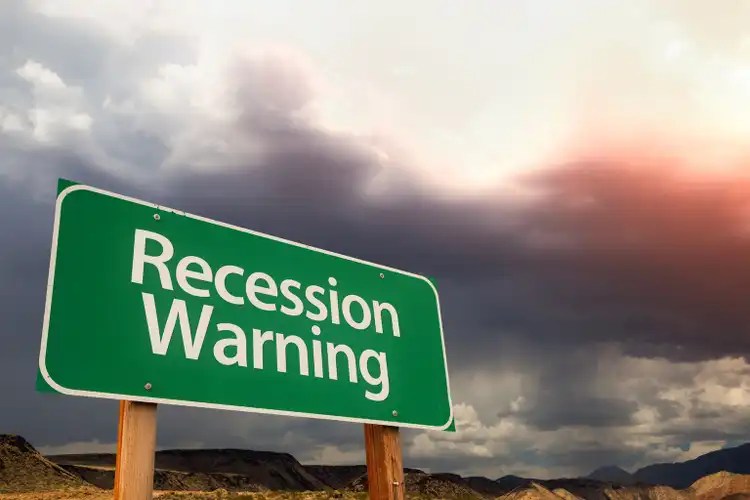
A Recession/ Heavy Recession is coming – why is no one paying attention??

As we peer into the foggy crystal ball of economic forecasting, one burning question persists: Will the economy see brighter days in 2024? With economists diligently crunching numbers and weighing probabilities, the outlook remains a swirling mix of hope and apprehension. According to a survey conducted by Wolters Kluwer Blue Chip Economic Indicators, experts anticipate a modest growth rate of 1.6% for the year ahead. However, alongside this cautious optimism looms the specter of a potential recession, with a 42% chance of economic contraction – a figure that, while slightly down from December’s forecast of 47%, still registers as historically high.

But what do these numbers mean for the average person navigating the complexities of daily life? Imagine it as akin to anticipating the weather forecast – you might keep an umbrella handy just in case, but the skies could clear up or unleash a storm at any moment. Meanwhile, the Federal Reserve finds itself in a precarious balancing act, contemplating potential interest rate cuts to bolster growth while grappling with the lingering impact of previous hikes, which threaten to hinder economic expansion.

Recent indicators suggest that the road ahead may indeed be fraught with challenges:

  1. Sluggish Growth: Despite initial hopes for a robust rebound, the economy’s forward momentum has been tepid at best. With GDP growth hovering around the 1.6% mark, economists express cautious concern, wary of potential impediments to sustained progress.
  2. Recession Risks: Though the odds of a recession have marginally decreased, they persist at a notable level of 42%. This figure serves as a stark reminder of the prevailing uncertainty and underscores the importance of remaining vigilant in the face of potential downturns.
  3. Fed’s Dilemma: The Federal Reserve confronts a conundrum as it navigates the delicate balance between stimulating growth and mitigating recessionary pressures. While the prospect of rate cuts looms on the horizon, the enduring effects of prior rate hikes pose a formidable obstacle to the Fed’s efforts to spur economic activity.

In the midst of these challenges, there’s an ominous whisper in the economic corridors – a foreboding sense that the storm clouds gathering on the horizon may herald a tempest far fiercer than anything we’ve seen before. Indeed, some voices in the financial realm warn that the looming downturn could surpass the magnitude of the 2008 financial crisis – a sobering thought that seems to fall on deaf ears amidst the cacophony of everyday life.

Reflecting on these challenges, investors and consumers alike are urged to adopt a prudent and diversified approach to financial planning. Monitoring economic indicators with vigilance and adapting strategies accordingly can help weather the storm of uncertainty. Despite the turbulences ahead, maintaining composure and confidence in the economy’s resilience remains paramount.

In conclusion, while the path ahead may be fraught with twists and turns, there exists cause for cautious optimism amidst the prevailing uncertainties. Armed with foresight and a readiness to adapt, individuals and institutions alike can navigate the complexities of 2024 and emerge stronger on the other side. As the age-old adage reminds us, fortune favors the prepared – and in the face of economic uncertainty, preparedness may indeed prove to be our most valuable asset.

  1. Michael Burry’s Betting: When Michael Burry, famously portrayed in “The Big Short,” starts making big bets against the market, it’s often seen as a warning sign. Burry has a track record of correctly predicting the housing market crash in 2008, and if he’s once again placing substantial bets against certain sectors or asset classes, it could indicate his belief that a recession is imminent.
  2. Yield Curve Inversion: Historically, when the yield curve inverts – meaning short-term interest rates rise above long-term rates – it has often preceded recessions. This phenomenon occurred before the 2001 recession and the 2008 financial crisis. If the yield curve begins to invert, it could signal trouble ahead for the economy.
  3. Declining Consumer Confidence: Consumer confidence is a key indicator of economic health. If consumers start to feel pessimistic about the economy and cut back on spending, it can have a ripple effect throughout the economy, leading to reduced demand for goods and services and potentially triggering a recession.
  4. Rising Unemployment: A significant increase in unemployment rates can be a red flag for an impending recession. When businesses start laying off workers or scaling back hiring, it’s often a sign that they’re anticipating a slowdown in economic activity.
  5. Corporate Debt Levels: High levels of corporate debt can be a ticking time bomb for the economy, especially if companies have trouble servicing their debt in a downturn. If corporate debt levels reach unsustainable levels and companies start defaulting on their loans, it can lead to a domino effect that contributes to a recession.
  6. Global Economic Slowdown: Economic indicators from around the world can provide valuable insights into the health of the global economy. If major economies like China or Europe experience a slowdown in growth, it can have knock-on effects on the U.S. economy and increase the likelihood of a recession.

These are just a few examples of signs that might indicate a recession is on the horizon. It’s essential to monitor a wide range of economic indicators and market signals to assess the likelihood of an impending downturn accurately.

People may be looking the other way for several reasons:

  1. Optimism Bias: There’s a natural tendency for people to be optimistic about the future and to downplay the possibility of negative outcomes like recessions. This optimism bias can lead individuals and businesses to overlook warning signs or rationalize away potential risks.
  2. Short-Term Focus: In today’s fast-paced world, people often have a short-term focus, prioritizing immediate concerns over long-term risks. This can lead to a lack of attention or concern about broader economic trends that may be unfolding gradually over time.
  3. Complexity of Economic Indicators: Economic indicators and financial markets can be complex and difficult to interpret, especially for the average person. As a result, many people may simply tune out or defer to experts, assuming that someone else will sound the alarm if there’s a genuine cause for concern.
  4. Confirmation Bias: People tend to seek out information that confirms their existing beliefs or biases while ignoring or dismissing contradictory evidence. If someone is convinced that the economy is doing well, they may discount or ignore evidence suggesting otherwise.
  5. Political Factors: Economic perceptions can be influenced by political factors, with individuals interpreting economic data through the lens of their political affiliations or beliefs. This can lead to selective attention or skepticism towards information that contradicts one’s political worldview.
  6. Lack of Financial Literacy: Many people have a limited understanding of economics and finance, making it difficult for them to interpret economic indicators or understand the potential implications of broader economic trends. Without a solid foundation in financial literacy, individuals may be ill-equipped to recognize warning signs of an impending recession.

Overall, a combination of cognitive biases, information overload, and a lack of understanding of economic principles can contribute to why people may be looking the other way when it comes to the possibility of a recession.